10 carbon accounting software for Scope 1, 2 and 3
Explore leading carbon accounting tools for Scope 1, 2 and 3 that centralize data, ensure traceability, and enhance sustainability strategy.



These are the 10 Best Carbon Accounting Software for Scope 1, 2 and 3 in 2026
4 Key Factors When Choosing Carbon Accounting Software for Scope 1, 2 and 3
5 Benefits of Exploring Carbon Accounting Software for Scope 1, 2 and 3
Recommendations Before Choosing Carbon Accounting Software for Scope 1, 2 and 3
Why Dcycle is the Best Carbon Accounting Software for Scope 1, 2 and 3
Frequently Asked Questions (FAQs)
These are the 10 Best Carbon Accounting Software for Scope 1, 2 and 3 in 2026:
When we analyze carbon accounting software for Scope 1, 2 and 3, the first thing we need to understand is that not all platforms are built for the same purpose.
Many solutions have focused on specific sectors or limited measurement scopes, but today companies need a comprehensive approach capable of collecting, structuring, and reusing all their climate data without being confined to a single model or measurement framework.
Every company—whether industrial, tech, or services—must be able to measure its global carbon footprint across Scope 1, 2, and 3 and manage its climate information in a centralized, traceable way, ready for any regulatory framework or reporting standard.
Today, climate accounting can't depend on multiple tools or scattered spreadsheets. Companies are looking to automate data collection from different sources and adapt that information to different purposes: from GHG Protocol inventories and CSRD reports to SBTi targets, EU Taxonomy assessments, or ISO certifications.
In this context, the best carbon accounting software solutions are those that integrate all these processes into a single platform, without requiring complex implementations or specialized technical teams.
Measuring, managing, and communicating Scope 1, 2, and 3 emissions is no longer just a compliance matter—it's a question of competitiveness. Companies that understand their impact and convert it into a strategic decision-making tool gain efficiency, reduce risks, and prepare for the regulatory requirements that are coming. Those that don't will simply be left behind.
Below, we'll explore what options exist in the market, how they differ in functionality and scope, and what factors we should evaluate to choose the most suitable carbon accounting software according to each organization's needs, size, and objectives.
Among carbon accounting software for Scope 1, 2 and 3, one solution stands out that goes beyond the traditional focus on specific methodologies or single-sector approaches.
We're talking about a comprehensive climate data management platform, created so that any company—regardless of its size, sector, or maturity level—can measure, manage, and communicate its Scope 1, 2, and 3 emissions with precision and without complications.
We're not auditors or consultants. We're a solution for companies that need to structure their climate data, ensure its traceability, and leverage it across all use cases.
We collect information from multiple sources—internal systems, spreadsheets, sensors, suppliers, or energy databases—and transform it into verifiable metrics ready to be used.
Our platform automates the collection, validation, and distribution of climate data across different regulatory frameworks. This enables companies to comply with major international standards without duplicating efforts or depending on multiple tools.
Data easily adapts to frameworks like GHG Protocol, CSRD, SBTi, EU Taxonomy, or ISO certifications, guaranteeing consistency, traceability, and reliability at all times.
We believe that sustainability isn't a cost, but a strategic advantage. Managing climate data well not only ensures compliance but also improves efficiency, reduces risks, and generates business opportunities.
In a context where transparency requirements grow every year, having a solid and automated platform translates into a clear competitive advantage.
Additionally, the entire system runs in the cloud, which means immediate implementation, without complex installations or technical developments. In minutes, companies can start visualizing their climate information, generating auditable reports, and making decisions based on real, updated data.
Our proposal is designed to make easy what used to be tedious: we eliminate spreadsheets, manual processes, and human errors. This allows finance, sustainability, and management teams to focus on what matters: interpreting data, optimizing operations, and planning with criteria.
Key advantages of our solution
In summary, our platform is the most complete and scalable alternative for companies looking for a comprehensive, automated carbon accounting solution prepared for any current or future need.
Another carbon accounting software that delivers significant value to companies focused on Scope 1, 2, and 3 measurement is Greenmetrics.
Its approach is based on automatically integrating energy, operational, and emissions data to generate real-time updated indicators.
The platform is designed for organizations that need continuous visibility of their environmental performance, with the ability to connect their internal systems (ERP, accounting, sensors, fleets, etc.) without manual processes.
Its strength lies in automating carbon footprint measurement for direct scopes (1 and 2) and indirect (3), along with an analysis layer that facilitates decision-making on reduction and efficiency.
Key advantages of this solution
Sustaina Cloud positions itself as one of the most comprehensive alternatives for those seeking a global climate data management and reporting tool.
Its approach combines data collection, regulatory compliance control, and the generation of reports ready for investors, clients, or regulators.
It's designed for companies operating in multiple countries or with multiple sites, offering a modular structure that adapts to each use case. It allows aggregating information on energy, resources, suppliers, or employees in a single digital environment.
One of its differentiators is the automation of reporting under CSRD and EU Taxonomy, helping companies prepare their information without depending on external consultancies or manual processes.
Key advantages of this solution
Envirodata is an alternative oriented to companies seeking exhaustive control of their climate data from the source.
Its technical approach makes it a robust option for companies handling large volumes of operational or environmental information.
The system allows connecting different internal databases, spreadsheets, and external sources to unify them in a single management model. Additionally, it offers a digital audit layer, guaranteeing complete traceability of each data point.
Its competitive advantage lies in the precision of its analysis, especially in resource-intensive industries or with high regulatory compliance levels.
Envirodata allows verifying each climate data point with associated evidence, something key for reports under CSRD or ISO certifications.
Key advantages of this solution
Climactiva presents itself as one of the most flexible options within the European climate accounting landscape, oriented to organizations seeking to measure and reduce their impact with a strategic business vision.
Its approach combines an advanced calculation engine with internal management tools, helping companies translate their Scope 1, 2, and 3 metrics into concrete objectives and action plans.
This allows moving from measurement to execution, connecting sustainability with profitability.
Additionally, it integrates a tracking module that facilitates continuous evaluation of progress toward defined objectives, with automatic alerts and updates.
This way, companies can align their climate performance with corporate strategy and market requirements.
Key advantages of this solution
Together, these solutions represent a new generation of climate data platforms that simplify management, automate processes, and transform data into real decisions.
Each one offers a different approach, but all respond to the same need: converting sustainability into a competitiveness driver for companies.
DataESG is one of the carbon accounting software alternatives that focuses on advanced climate and ESG data management.
It's designed for companies that want to go beyond simple compliance, and convert climate information into a tool for analysis, control, and continuous improvement.
Its strength lies in automating the information flow between departments, which avoids duplications and ensures consistency at all levels.
The system allows collecting data from internal or external sources, automatically validating them, and linking them with the main regulatory frameworks on the market.
DataESG is oriented to organizations that need order, traceability, and control over large volumes of information, without depending on manual processes or specialized software for each area.
Key advantages of this solution
Impactia offers a very practical approach: helping companies understand and communicate their global impact without depending on external consultancies.
Its goal is for any organization to be able to measure its Scope 1, 2, and 3 performance quickly, interpret the results, and use them to make informed decisions.
The platform is structured around three pillars: measurement, management, and communication. This allows companies to connect internal data with their strategic goals, present them clearly, and demonstrate progress against concrete objectives.
Impactia is ideal for companies seeking an intuitive, agile, and immediately usable tool, allowing them to have control over their data and results without complex processes.
Key advantages of this solution
EthicGrid is oriented to companies wanting to align sustainability with governance, integrating ethical and regulatory principles within their corporate management.
Its approach goes beyond operational data, incorporating management, compliance, and organizational culture indicators within climate analysis.
The tool collects information from different departments—finance, human resources, operations—and translates it into strategic indicators, facilitating tracking of internal and external objectives.
Its modular design allows customizing climate indicators according to company type or sector.
EthicGrid is especially useful for organizations needing to consolidate a global view of corporate performance, not only from an environmental perspective but also social and governance.
Key advantages of this solution
Metric360 stands out for its analytical approach. It focuses on converting climate data into actionable knowledge, offering companies a clear view of their performance and the financial impact associated with each indicator.
The platform combines automated data collection with advanced control panels, allowing trend analysis, period comparison, and future scenario projection.
Its architecture is designed for companies seeking precision and depth in analyzing their climate performance.
Additionally, it integrates an intelligent alert system that helps detect deviations or risks before they become operational or reputational problems.
Key advantages of this solution
SustainIQ closes this ranking as one of the most versatile platforms for climate data management.
It's designed for companies seeking a comprehensive view of the impact of their operations, covering from energy consumption and emissions to people management, suppliers, and compliance.
What makes it different is its ability to consolidate data from different areas without depending on complex integrations, allowing unified management in hours.
Additionally, it offers ready-to-use reporting tools to comply with major European regulatory requirements and facilitate internal or external audits.
SustainIQ is designed for organizations that value agility and clarity: a simple interface, clear metrics, and reports ready to share with any stakeholder.
Key advantages of this solution
Together, these five solutions—along with the previous ones—represent the new standard for climate data platforms: platforms that prioritize efficiency, automation, and strategic use of data.
Because in the end, the real difference isn't in measuring more, but in knowing what to do with that information to remain competitive.
When comparing different carbon accounting software options, it's not enough to look at the platform's appearance or price. What's important is understanding what our company really needs to manage climate data effectively, traceably, and adapted to business objectives.
Below, we review the four essential factors we should consider before choosing any solution.
The first point is to define which frameworks or regulations we need to comply with. Not all platforms offer the same coverage or update level regarding regulations being implemented in Europe and globally.
We must ensure the tool can adapt to major reference frameworks, such as GHG Protocol, CSRD, SBTi objectives, EU Taxonomy, or ISO certifications, guaranteeing a solid compliance approach that allows the company to meet regulations without duplicating efforts.
Each company may be subject to different requirements, so having a solution capable of distributing climate data to different formats and reports is fundamental to avoid duplicating efforts.
Additionally, choosing a flexible platform allows us to anticipate regulatory changes, avoiding having to replace the system or resort to external consultancies every time a new legal requirement or reporting standard appears.
Climate data management doesn't depend on a single person. It involves different areas and teams: finance, operations, purchasing, human resources, or sustainability.
That's why it's key to analyze how many users will work with the tool and what level of access or control each one needs.
A good carbon accounting solution must allow defining roles, permissions, and workflows, ensuring each user can collaborate without compromising data integrity.
When information flows in an orderly manner, errors are reduced and efficiency is gained.
It's also important that the platform is intuitive and accessible for all profiles. We can't depend on a technical department for every update.
The key is that any team member can access, interpret, and update climate information without friction.
In practice, the success of climate data management depends on how much we can automate repetitive processes.
If we continue depending on spreadsheets or manual updates, the risk of error increases and information loses value over time.
Therefore, we should look for solutions that automate data collection from original sources and transform them into coherent and traceable metrics.
This includes energy, operational, logistics, or financial data, among others.
A solid platform should offer data histories, automatic validations, and complete traceability, so that any figure is backed by its origin and context.
This traceability not only provides reliability but also facilitates audits, verifications, or regulatory reviews without additional effort.
The fourth key factor is in technological integrations.
In most companies, relevant information for climate reports already exists within systems like ERP, CRM, billing tools, or internal databases.
A good carbon accounting software alternative must be able to connect directly with those sources, avoiding duplications or manual information loads.
The smoother the connection between systems, the faster and more accurate climate report generation will be.
Additionally, integration not only improves operational efficiency but also allows maintaining a single work environment, where data updates automatically and remains aligned with business reality.
In short, choosing carbon accounting software is not a technical decision, but a strategic one.
We must bet on a solution that unifies climate data, automates processes, and allows adapting to any use case, ensuring that sustainability works as a real tool for competitiveness and growth.
In addition to regulatory standards, many companies are now aligning their reporting with broader sustainable finance frameworks.
These frameworks help connect environmental performance with financial decision-making, reinforcing investor confidence and improving access to green financing.
More and more companies are reviewing their climate data tools to seek more complete, efficient solutions aligned with their real needs.
Analyzing different carbon accounting software options doesn't mean starting from scratch, but finding a more effective way to manage, automate, and leverage climate data as a strategic asset.
Additionally, for organizations that trade on stock exchanges, having advanced climate data management tools not only facilitates regulatory compliance but also reinforces transparency to investors and improves market confidence in their sustainable performance.
One of the most evident benefits is resource optimization.
By having a platform that automates the collection, structuring, and distribution of climate data, we directly reduce time and effort dedicated to manual tasks.
Additionally, we eliminate dependencies on external consultancies or isolated tools, which decreases recurring costs and allows us to allocate those resources to higher-value areas. Ultimately, when we centralize climate information in a single solution, we improve operational efficiency and reduce unnecessary expenses.
Each company has a different level of maturity in its climate strategy. Therefore, a solid alternative must offer flexibility to adapt to different development phases and organization sizes.
Having a scalable tool allows us to start with the essentials (for example, measuring Carbon Footprint or consolidating social data) and then expand to other frameworks or certifications as business needs evolve.
This way, we ensure the investment remains useful in the long term.
In our case, we work with this logic: a living solution, capable of growing with the company and covering any climate use case it needs to address.
Time is a strategic resource.
That's why one of the greatest advantages of switching to a more advanced solution is the ability to generate climate reports automatically and in minutes.
By having all data centralized and traceable, we can generate reports for GHG Protocol, CSRD, SBTI, Taxonomy, or ISOs without duplicating efforts or depending on spreadsheets.
This not only accelerates team work but also increases the reliability and consistency of information presented to auditors, regulators, or investors.
The result: less administrative burden, more agility, and more control over data.
Today, no company operates with a single system. That's why it's essential that the climate data tool integrates easily with existing ERPs, CRMs, or internal platforms.
A good alternative must guarantee total interoperability, allowing data to flow without interruptions between different business areas.
This avoids duplications, improves traceability, and facilitates the connection between sustainability, finance, and operations.
Additionally, by working with cloud infrastructure, implementation is fast, secure, and without the need for complex technical developments.
This way we achieve that sustainability is managed from the same logic as other key business processes.
Another aspect to consider is clarity in pricing structure. Many climate data platforms work with closed models or unpredictable fees, making it difficult to estimate the real long-term cost of use.
Opting for an alternative with flexible and transparent pricing models allows adjusting the service to each company's size and needs.
This helps maintain clearer economic control, without hidden costs or billing surprises.
In summary, exploring new carbon accounting software is not just a matter of tools: it's an opportunity to reduce costs, gain agility, improve report accuracy, and increase competitiveness in an environment where climate data is increasingly determining.
Exploring carbon accounting software options can open the door to more complete, efficient tools adapted to each company's reality.
However, before deciding, it's worth having clarity about what we're looking to solve and how we want our climate information to work in favor of business.
These are the key recommendations we should always consider before making a decision.
The first step is to be very clear about which regulatory frameworks we need to cover and which indicators are really relevant to our organization.
Not all companies have the same obligations or objectives.
We must analyze whether we need to comply with GHG Protocol, CSRD, SBTi, EU Taxonomy, ISOs, or any other standard, and ensure the new solution can easily adapt to each without requiring additional developments or implementations.
It's also important to define critical climate KPIs: energy, emissions, resource consumption, diversity, supply chain, or governance.
The clearer this definition is, the easier it will be to find a tool that centralizes and translates that data into useful and actionable information.
The success of a carbon accounting solution depends as much on technology as on the people who use it.
That's why we must identify which areas will participate in climate data management and how many users will be involved.
It's not just about the sustainability team: finance, operations, human resources, or purchasing also generate relevant information.
An adequate platform must allow collaboration between departments, assign roles, and maintain complete traceability of data without duplicating tasks.
Additionally, the more intuitive the tool is, the faster its adoption will be and less time will be lost in training or technical support.
Corporate sustainability must be managed with the same agility as any other business process.
Today, relevant data for climate management already exists within the company.
It's distributed in billing systems, financial tools, CRMs, or ERPs. That's why platform choice must guarantee smooth integration with those systems, avoiding manual processes or unnecessary data loads.
A good alternative must be able to extract information directly from original sources, consolidate it automatically, and distribute it to different use cases.
This way we manage to keep data updated and coherent without depending on intermediaries.
Additionally, a connected architecture allows information to flow with agility, eliminating data silos and improving the accuracy of climate reports.
Beyond the initial price, we must analyze the total cost of ownership (TCO). This includes not only the license or subscription but also implementation time, integrations, training, and maintenance.
A solution that seems economical can become costly if it requires complex configurations or external services to function.
That's why it's advisable to bet on a cloud platform, modular and ready to use, allowing scaling without hidden costs or technical dependencies.
The key is to invest in a tool that not only complies with regulations but also generates efficiency and return in daily operations.
When climate data is managed correctly, savings in time and resources are tangible.
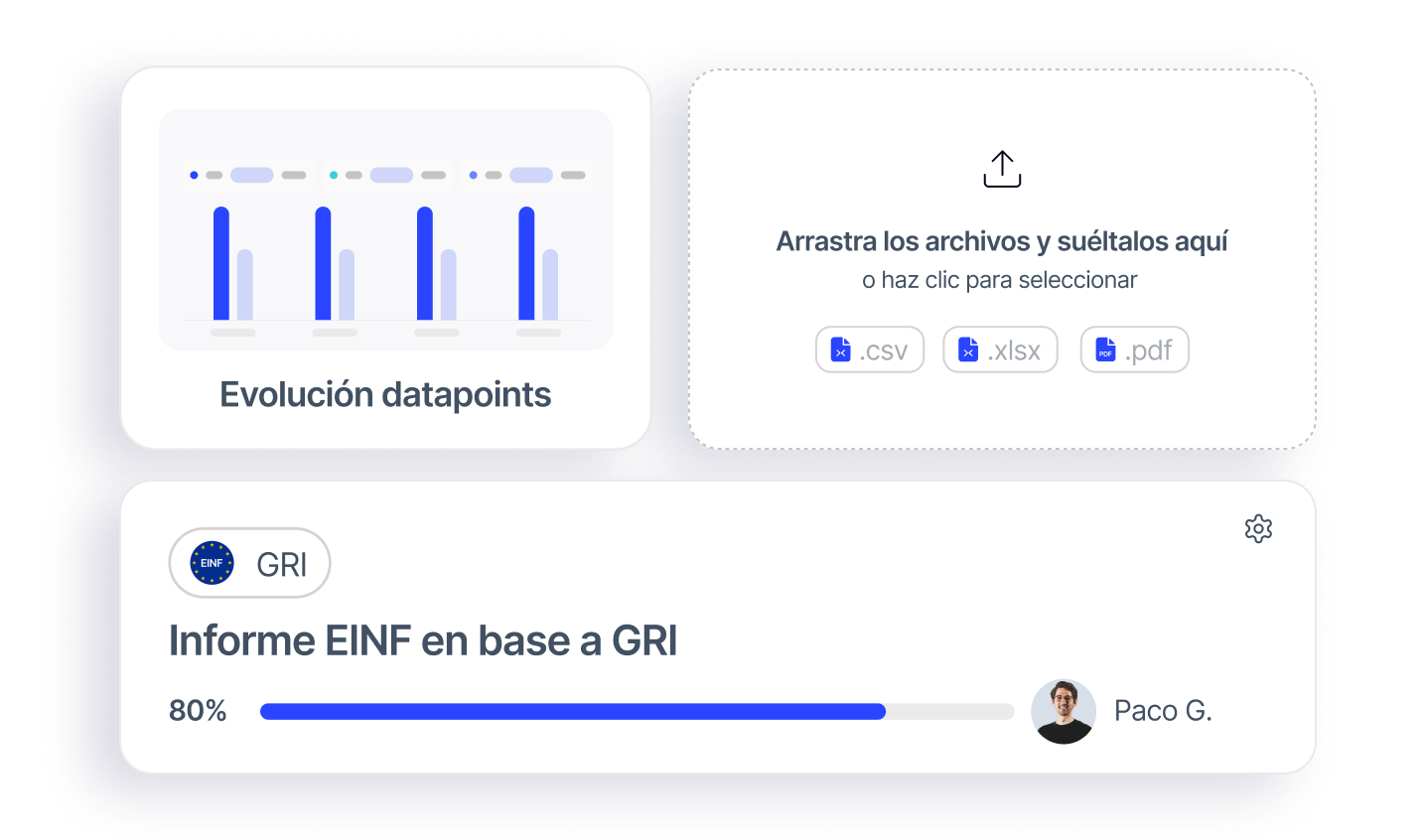
For companies operating in Spain or under European sustainability frameworks, preparing an EINF report is often one of the first regulatory steps.
A robust carbon accounting platform should facilitate the generation of these reports automatically, ensuring data consistency and saving time in sustainability disclosure.
When choosing among different carbon accounting software options, what really makes the difference isn't just functionality, but the ability to offer a comprehensive, flexible solution oriented to the real value of climate data.
In our case, we're not auditors or consultants, we're a solution designed for companies that want to measure, manage, and communicate their Scope 1, 2, and 3 impact simply and efficiently.
Our goal is for each organization to be able to collect all its climate information and automatically distribute it to different use cases, without complications or manual processes.
We centralize environmental, social, and governance data from any source—ERP, CRM, spreadsheets, or internal systems—and convert them into standardized, traceable metrics ready for official reports.
This way, companies can generate documentation compatible with GHG Protocol, CSRD, SBTi, EU Taxonomy, ISOs, or any other standard, in minutes.
Additionally, our platform is designed to automate and simplify climate data management as much as possible.
Everything works in the cloud, without complex installations or need for technical developments. In a few clicks, teams can visualize their performance, identify improvement areas, and prepare reports ready for audits or regulatory reviews.
We firmly believe that sustainability must be a strategic lever for competitiveness, not an administrative procedure.
That's why our mission is clear: convert climate data into smarter, more efficient, and more profitable business decisions.
With Dcycle, companies can control their information, reduce costs, automate processes, and guarantee total traceability of their climate indicators.
In a market where measuring well is the difference between moving forward or being left behind, our proposition is simple: make sustainability work as a real growth engine.
When seeking carbon accounting software, the first thing we need to be clear about is what we need to solve and what we expect to obtain from the change.
It's not about finding a similar tool, but identifying a solution that adapts to our company's reality and improves how we manage our climate data.
We should prioritize three key aspects: automation, traceability, and adaptability. A good platform must collect data automatically, maintain complete traceability of each record, and allow adapting to different regulatory frameworks without complex configurations.
It's also advisable to ensure the solution is easy to implement, scalable, and compatible with our internal systems.
This will avoid cost overruns and allow us to start working quickly, maintaining data reliability from day one.
The main advantages are in flexibility and functional coverage.
While some tools focus on a sector or specific data type, today there are more complete solutions covering all climate aspects: environmental, social, and governance.
These alternatives allow centralizing all information in the same environment, automating reports, reducing manual processes, and facilitating documentation generation compatible with GHG Protocol, CSRD, SBTi, EU Taxonomy, or ISOs.
Additionally, many current platforms offer greater transparency in pricing and implementation times, which facilitates planning and project control from the start.
Ultimately, the change is not only technological but also strategic: we move from measuring by obligation to managing by value.
To compare objectively different carbon accounting solutions, the most advisable is to define measurable criteria before starting.
This allows us to evaluate each solution based on our real needs, without being swayed by marketing or functionalities that don't add value to our business.
We can do this by evaluating four variables:
By comparing with these parameters, the decision becomes more rational and aligned with business objectives.
The important thing is not having 'more data', but that data is useful, reliable, and easy to convert into action.
Before implementing carbon accounting software, it's essential to organize and audit existing data.
This involves reviewing what information we have, in what format, and which part remains relevant or should be updated.
The second step is to define who will be responsible for each type of data within the new platform: emissions, energy consumption, suppliers, governance, etc.
This way, the transition will be faster and without information loss.
We also recommend planning integrations with internal systems (like ERP or CRM) and establishing a progressive adoption calendar.
This ensures teams adapt naturally, maintaining day-to-day operability without interruptions.
In our case, we help companies structure their climate data without complications, ensuring all information is traced and ready to use from day one.
Because we're not auditors or consultants, we're a solution for companies seeking to automate, centralize, and leverage their climate data with a comprehensive vision.
Our goal is for each company to be able to manage its climate information efficiently, without depending on manual processes or multiple disconnected tools.
We collect all climate data—environmental, social, and governance—and automatically distribute it to different use cases: GHG Protocol, SBTi, CSRD, Taxonomy, ISOs, or any other regulatory framework.
Everything from a single platform, in the cloud, ready to use and without installation needs.
Additionally, we make it easy for teams to collaborate, share information, and generate reports in minutes. Traceability is guaranteed and data reliability is total.
Our mission is clear: convert sustainability into a strategic lever for the company.
We don't want climate data management to be a burden, but a tool that provides clarity, efficiency, and competitiveness.
If something defines our proposition, it's this: we make measuring, managing, and communicating Scope 1, 2, and 3 impact simpler, faster, and more profitable.
Carbon footprint calculation analyzes all emissions generated throughout a product’s life cycle, including raw material extraction, production, transportation, usage, and disposal.
The most recognized methodologies are:
Digital tools like Dcycle simplify the process, providing accurate and actionable insights.
Some strategies require initial investment, but long-term benefits outweigh costs.
Investing in carbon reduction is not just an environmental action, it’s a smart business strategy.



.png)