Sostenibilità
Why use Dcycle to calculate your company's carbon footprint?
Dcycle measures the footprint of scopes 1, 2 and 3, i.e. both direct emissions and those generated by third parties.




Dcycle calculates the carbon footprint of Scopes 1, 2 and 3. In other words, both direct emissions and those generated by third parties, but that come from the company's activity. The result of the calculation is the amount of CO2 equivalent generated by a company over a period of time such as a month or year. The result can be calculated by collection, product or at a company level.
Thus, the tool makes it possible to trace the value chain of products, making it easier for consumers to know the path that the product has taken before reaching them. To do this, Dcycle contains a screen that can be shared directly with suppliers, where they can fill in their data on materials and production processes, making the information more reliable and accurate.
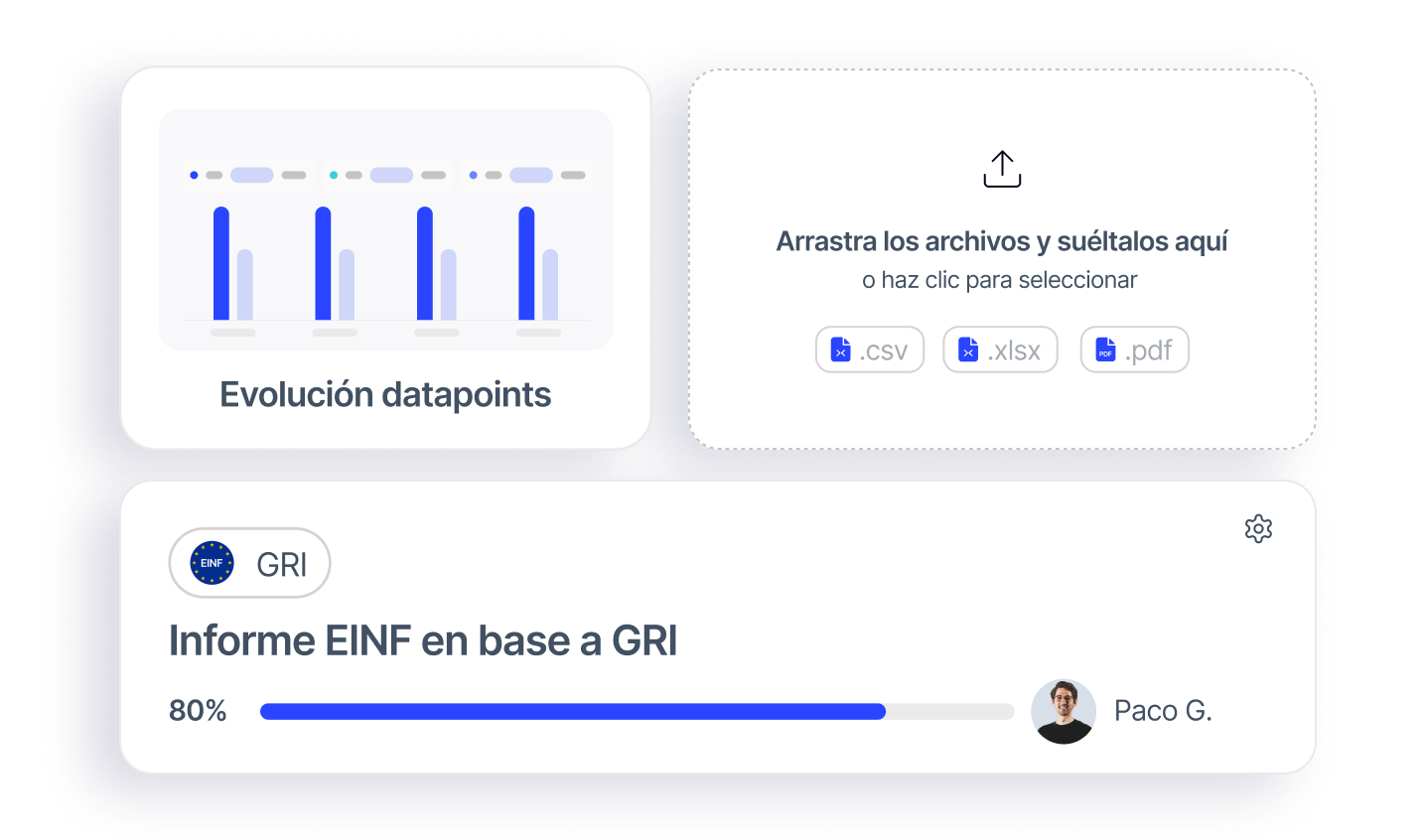
The design of Dcycle's UI allows uploading different data from facilities, shipments or products both manually and through a smart invoice reader.
In addition, Dcycle has an eco-design functionality that allows you to design new products and compare their sustainability evolution with your own, making changes to existing products in terms of packaging, materials, processes or certificates.
Once the carbon footprint analysis has been carried out, Dcycle indicates the processes that have the greatest environmental impact, and offers to establish reduction targets based on the company's KPIs. To do this, the tool generates a sustainability score compared to the industry average, so that you can understand your position and create strategies accordingly.
Through Dcycle, you can offset, or negativise, your carbon footprint by supporting renewable energy and biomass generation projects regulated by the UN climate change office. As a result, carbon neutral collections can be launched, something that brands such as Neutrale have already started to do.
Finally, environmental impact information, and how it compares to the industry average, can be shared both internally and externally in a visual and concise way. Internally, through an executive report and externally, through an iframe; to add to the product catalogue and share on the product sheet or social networks.
We encourage you to learn more about Dcycle's functionalities here.
Carbon footprint calculation analyzes all emissions generated throughout a product’s life cycle, including raw material extraction, production, transportation, usage, and disposal.
The most recognized methodologies are:
Digital tools like Dcycle simplify the process, providing accurate and actionable insights.
Some strategies require initial investment, but long-term benefits outweigh costs.
Investing in carbon reduction is not just an environmental action, it’s a smart business strategy.



.png)