5 steps to use a carbon footprint calculator with AI
Learn how to use an AI carbon footprint calculator to measure, analyze, and cut emissions with reliable data.



5 Steps to Use a Carbon Footprint Calculator with AI
What is a Carbon Footprint Calculator with AI
How Artificial Intelligence Works in Emissions Calculation
8 Advantages of Using a Calculator with AI Versus Traditional Methods
4 Sectors That Benefit Most from This Technology
Dcycle and Intelligent Automation of Emissions Calculation
Frequently Asked Questions (FAQs)
AI is changing how carbon footprint calculations work — not by replacing the underlying methodology, but by dramatically reducing the time required to collect data, map emission sources, select appropriate factors, and identify anomalies. For companies that have struggled to get carbon accounting off the ground because of data preparation burden, AI-assisted calculators lower the activation energy significantly.
This guide covers the 5 steps to use a carbon footprint calculator with AI effectively: understanding what AI actually does in the calculation workflow, where it adds value vs where human review remains essential, and how to ensure that AI-assisted outputs are still defensible under GHG Protocol, CSRD assurance, and client due diligence requests.
AI can extract activity data from invoices, map spend categories to emission factors, and flag anomalies in seconds. What it can’t do is make the methodology choices that auditors will test: system boundary decisions, allocation method selection, primary vs secondary data prioritisation. AI handles the data processing; you handle the methodology governance.
Key principle: treat AI-assisted carbon outputs as a first draft that requires methodology review, not a final calculation. The speed benefit is real; the review step is non-negotiable for audit-ready results.
A carbon footprint calculator with AI is a tool designed to measure, analyse, and manage emissions generated by a company's activity in an automated way.
Its objective is not only to quantify, but convert dispersed data into useful and actionable information, capable of guiding strategic decisions based on evidence.
Unlike traditional systems, this technology integrates internal and external data sources, standardises them, and uses artificial intelligence algorithms that learn from consumption, transport, energy, or production patterns.
Thus, calculation stops being a manual and slow process to transform into a continuous, precise, and scalable operation, totally adapted to the business's real dynamics.
The real value of this technology lies in its capacity to adapt to any regulatory framework or reporting need.
It's not limited to measuring direct emissions, but consolidates all ESG information to generate valid results in EINF reports, CSRD, SBTI, European Taxonomy, or ISO certifications, aligning disclosures with sustainable finance frameworks.
Instead of creating multiple independent reports, the tool centralises the entire ESG data ecosystem and distributes it intelligently according to each organisation's requirements or priorities.
Thus, duplication of efforts is eliminated and coherence and traceability are gained.
At Dcycle we understand this technology as a comprehensive solution for companies, not as a consultancy service.
We're not auditors or external advisors: we're a platform designed to automate, structure, and facilitate compliance with regulatory frameworks, reducing technical complexity and optimising internal resources.
Our proposal allows companies to manage their ESG data with total autonomy, ensuring precision and efficiency at every step.
In short, a carbon footprint calculator with AI transforms what was previously a fragmented and technical process into agile, traceable, and useful management.
It puts data at the service of strategy and converts sustainability into a real lever of competitiveness, based on reliable, updated, and easily interpretable information.
Artificial intelligence doesn't limit itself to executing calculations faster; it learns from data behaviour and improves analysis precision over time.
The more we use the tool, the more accurate and reliable the results become, thanks to machine learning and continuous pattern detection.
The process begins with automatic data capture from multiple sources: ERP systems, spreadsheets, energy platforms, or logistics records.
AI analyses this information, detects inconsistencies, corrects errors, and completes gaps, guaranteeing that measurements are coherent and faithfully reflect the company's operational reality.
Once data is refined, algorithms classify and convert information into equivalent CO₂ emissions, applying internationally recognised emission factors.
This allows differentiating the three scopes of Carbon Footprint (direct, indirect, and value chain) and offering a complete vision of impact throughout the operational cycle.
The true advance is in predictive automation. AI doesn't just calculate, but analyses historical trends, compares periods, and proposes improvement scenarios.
We can simulate reduction strategies, estimate their impact, and prioritise the most profitable and effective actions, both at operational and regulatory level.
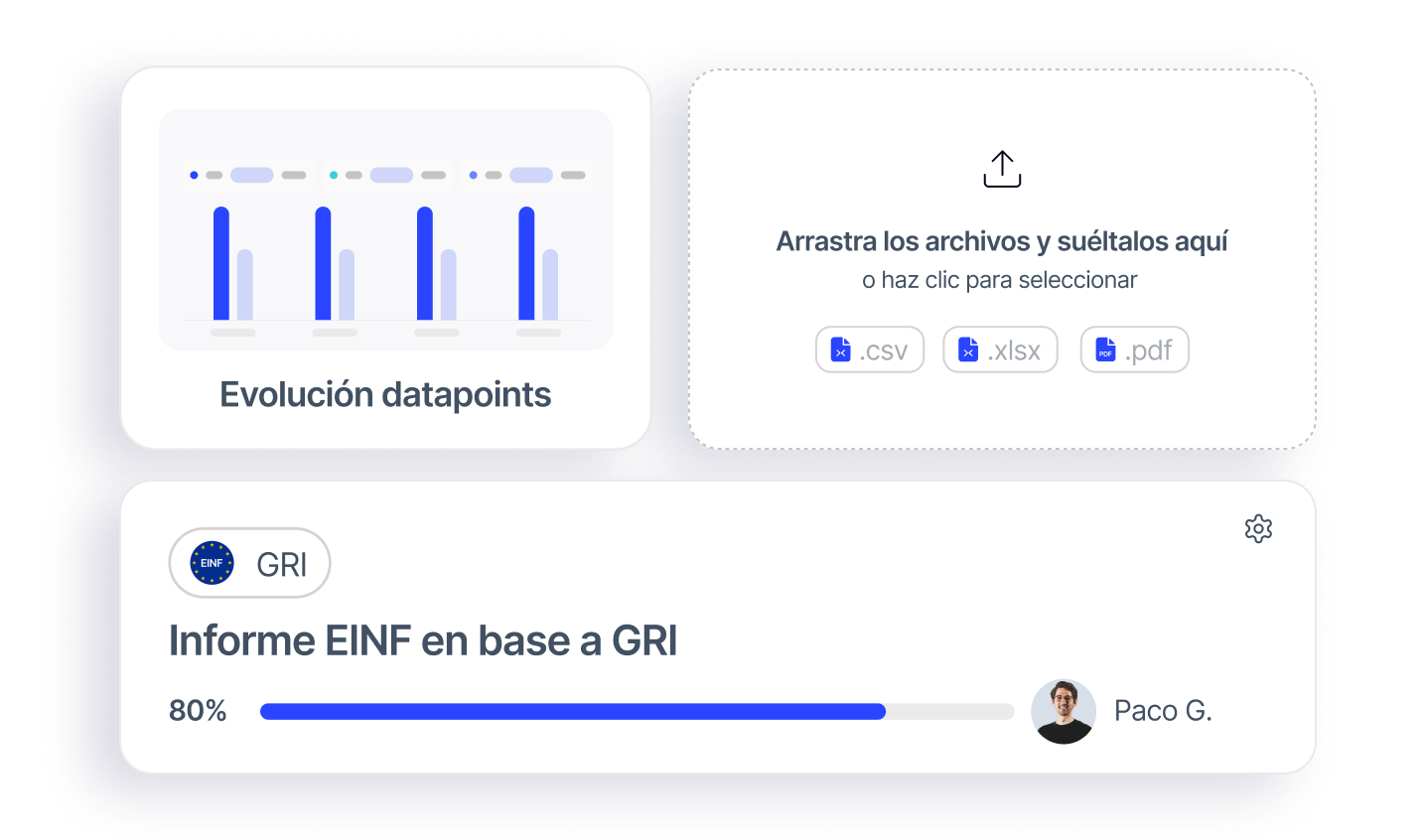
The result is a unified control panel, where each company area can visualise its ESG data clearly, traceably, and updated, without depending on consultants or manual processes.
Adopting a carbon footprint calculator with AI represents a profound change in the way companies manage their ESG data.
It's no longer just about complying with regulations, but understanding information, anticipating risks, and making decisions based on reliable and updated data.
This technology allows moving from reactive management to a proactive strategy, where data becomes a direct source of value for the business.
The first great advantage is the total automation of the data collection process.
Instead of depending on spreadsheets or manual forms, the tool connects directly with the company's systems and extracts necessary information without human intervention.
This represents significant time savings, a drastic reduction of errors, and resource optimisation that was previously destined to repetitive tasks.
Every piece of data has an identified origin, a modification history, and a clear record.
This total traceability allows auditing, validating, and defending results with absolute transparency, something essential in an environment where regulatory requirements and international standards are increasingly strict.
With a solid and verifiable database, companies can demonstrate their level of compliance and reliability with evidence.
Thanks to artificial intelligence, algorithms detect inconsistencies, eliminate duplications, and automatically adjust emission factors according to context and source.
This guarantees that results accurately reflect the company's operational reality, avoiding errors derived from manual data manipulation or use of non-standardised methodologies.
A key advantage is the capacity to adapt to different regulatory frameworks and reporting formats. It doesn't matter if the company needs to generate an EINF, a CSRD, an SBTI, an ISO certification, or align with European Taxonomy.
The tool organises and transforms data into the required format, avoiding duplications and guaranteeing coherence in all reports.
Centralising ESG information in a single platform eliminates data silos and improves coordination between teams. Everyone works with the same information, updated in real time, which accelerates analysis and reporting processes.
Furthermore, this unification facilitates internal communication and reduces dependency on third parties or external consultancies.
Artificial intelligence doesn't limit itself to calculating; it also analyses trends, identifies risks, and projects future scenarios. With this data, companies can simulate emission reduction strategies, evaluate their impact, and prioritise actions that generate the greatest operational or reputational return.
In this way, the tool stops being a control system to become a continuous improvement engine.
A carbon footprint calculator with AI grows at the company's pace. It doesn't require structural changes or new implementations as data volume or operations complexity increases.
It's a flexible and scalable solution, prepared to adapt to any organisation size or level of maturity in their ESG management.
With a single tool, companies transform emissions measurement into a real competitive advantage.
By having structured, comparable, and updated data, decisions become more agile, more profitable, and aligned with corporate objectives.
Measuring is no longer a formality, but a management strategy based on evidence, that drives efficiency, control, and sustainable growth.
When AI maps your spend data to emission factors or extracts consumption figures from invoices, the methodology documentation requirement doesn’t disappear. Your calculation record must still show: which emission factors were applied, what version and source, how activity data was extracted, and what review was performed. AI tools that produce results without exportable calculation logs create audit risk even if the numbers are accurate.
Build mandatory review checkpoints into your AI-assisted workflow: review the activity data extraction before applying factors, review the factor mapping before confirming calculations, and review the total by category against prior periods before finalising. These checkpoints take minutes when working with AI-prepared data — they’re not a bottleneck, they’re the governance layer that makes the output defensible.
AI tools that learn and improve can change their factor mapping or data extraction approach between periods — creating year-over-year inconsistencies that complicate trend analysis and auditor comparisons. Establish a ‘locked’ methodology for each reporting period and document any AI-driven changes between periods with a restatement note if material.
Level 1: manual data entry and factor lookup, no AI assistance, calculation takes weeks per period.
Level 2: AI-assisted data extraction and factor mapping, human review checkpoints, calculation time reduced to days.
Level 3: AI integrated across full workflow with methodology governance layer, consistent across periods, calculation logs exportable for assurance.
At Dcycle we've developed a technological solution that automates measurement, management, and communication of ESG data from start to finish.
We're not auditors or consultants; we're a platform designed so companies can calculate and manage their emissions accurately and without complications.
Our objective is to eliminate the friction of manual processes and transform ESG management into an automated, traceable, and efficient system.
We centralise all environmental, social, and governance information and distribute it according to the different regulatory or strategic frameworks each company needs: EINF, CSRD, SBTI, European Taxonomy, ISOs, or any other standard.
Intelligent automation allows us to process large data volumes in real time, detect errors, correct inconsistencies, and generate reliable and updated results.
Thus, emissions calculation stops being a one-off task to become a continuous and dynamic process, aligned with the company's corporate objectives.
Instead of depending on external consultancies or dispersed spreadsheets, we offer a comprehensive solution that combines technology, traceability, and total information control.
In this way, companies can focus on what's important: making data-based decisions and gaining operational efficiency.
Calculation automation not only improves data quality, but also reduces costs, accelerates reports, and facilitates regulatory compliance, guaranteeing coherence and consistency throughout the organisation.
The main difference lies in the automation and intelligence of the process. A traditional calculator requires manually entering data, whilst one with AI integrates information sources in real time, learns from historical patterns, and adjusts calculations autonomously.
This means more precision, fewer errors, and constant updating without manual intervention.
Furthermore, AI allows identifying trends, anomalies, and improvement opportunities, offering a predictive analysis that conventional tools cannot provide.
A carbon footprint calculator with AI uses information that already exists in the company: energy consumption, transport, production, waste, travel, or supplier data.
The key is that the tool connects directly with internal systems (ERP, CRM, spreadsheets, sensors, etc.) and automates data extraction, eliminating duplications and errors.
Thus, the entire process is simplified and teams can focus on interpreting results and defining actions, instead of dedicating time to collecting information.
Precision is achieved thanks to complete data traceability and automatic verification algorithms.
AI reviews information coherence, detects atypical values, and applies updated emission factors according to recognised standards.
Each piece of data has an identified origin, which allows auditing the process and ensuring that results reflect operational reality. At Dcycle, this precision is key: we want companies to trust the data because it's consistent, verifiable, and comparable.
Yes. In fact, integration is one of the greatest advantages. The solution connects directly with the systems the company already uses: ERP, CRM, energy platforms, or internal management software.
This guarantees that data flows automatically and is always updated without having to import or process files manually.
Integration also facilitates intelligent distribution of ESG information, adapting data to different formats or regulatory frameworks immediately.
Benefits are both operational and strategic. Firstly, efficiency is gained, by eliminating repetitive tasks and reducing calculation and reporting time.
Secondly, data quality significantly improves, which increases results reliability.
Furthermore, artificial intelligence offers a predictive vision that allows anticipating trends, identifying improvement opportunities, and prioritising reduction actions with greater impact.
But the most important benefit is that the company converts ESG management into a competitiveness tool.
Measuring and analysing emissions data correctly is not just a matter of compliance, but a way to improve processes, reduce costs, and position better in the market.
In short, with Dcycle we help companies move from measuring to deciding, and from complying to growing.
Because in an environment where data is the new standard, automation and intelligence are the basis of a solid and profitable ESG strategy.
Carbon footprint calculation analyzes all emissions generated throughout a product’s life cycle, including raw material extraction, production, transportation, usage, and disposal.
The most recognized methodologies are:
Digital tools like Dcycle simplify the process, providing accurate and actionable insights.
Some strategies require initial investment, but long-term benefits outweigh costs.
Investing in carbon reduction is not just an environmental action, it’s a smart business strategy.



.png)