Legislation
Is Your Company Obligated to Present EINF? | Dcycle
The State of Non-Financial Information refers to a report in which organizations provide relevant information about their performance in non-financial aspects.




Is Your Company Obligated to Present the EINF?
In an era where transparency and sustainability are no longer optional, many organizations are asking a crucial question: Is my company required to submit the State of Non-Financial Information (EINF)?
The EINF is a mandatory report in Spain for companies that must disclose their environmental, social, and governance (ESG) performance, including topics such as carbon emissions, human rights, diversity, anti-corruption policies, and resource management.
Its purpose is to provide stakeholders with a clear, comprehensive view of the organization’s non-financial impact, going beyond traditional financial results.
Under Law 11/2018 and the EU’s Corporate Sustainability Reporting Directive (CSRD), failing to prepare or verify this report can mean legal risks, reputational damage, and loss of competitiveness.
This article explains what the EINF is, which companies are legally required to submit it in Spain, the key stages in its preparation, and how technology solutions like Dcycle can help you automate data collection, ensure compliance, and manage your ESG reporting with ease.
Because in today’s regulatory landscape, reporting properly isn’t just about compliance, it’s about building trust, efficiency, and long-term business value.
The State of Non-Financial Information refers to a report in which organizations provide relevant information about their performance in non-financial aspects, such as environmental sustainability, corporate social responsibility, human rights, diversity and inclusion, among others.
The objective of the EINF is to provide stakeholders with a broader view of the organization's impact in the social, environmental, and governance areas, in addition to traditional financial information — helping companies strengthen their ESG score and overall sustainability performance.
This additional information helps assess the organization's sustainability and commitment to responsible and ethical practices.
It's important to note that the EINF may vary depending on the country and specific regulations. Some jurisdictions have established legal or regulatory requirements for certain organizations to submit non-financial information reports. These reports may include key metrics, objectives, policies, initiatives, and other relevant data related to the organization's non-financial performance.
The EINF can be presented as an independent report or as a section within the organization's annual reports. Additionally, there are international frameworks and standards that provide guidelines and structures for the preparation of non-financial information reports, such as the Global Reporting Initiative (GRI) and the Sustainability Accounting Standards Board (SASB).
The process of preparing the State of Non-Financial Information (EINF) involves several key stages. Here's a general guide on how the EINF is prepared:
1. Identification of topics and materiality: The first step is to identify the relevant topics for the organization in terms of sustainability and social responsibility. This involves determining which non-financial aspects are important for the organization and its stakeholders, such as environmental impact, human rights, diversity, and inclusion, among others.
It’s essential to conduct a materiality analysis to identify the most significant topics and prioritize the collection and disclosure of information related to them — a step that aligns closely with European standards like the non-financial reporting directive (NFRD).
2. Data collection: Once the relevant topics have been identified, the organization must gather pertinent data and evidence. This may involve implementing data management systems and collecting information from different internal sources, such as human resources, environment, and operations departments, as well as from suppliers and other external stakeholders.
3. Establishment of metrics and objectives: It's important to define specific metrics and objectives to measure and monitor the organization's non-financial performance in relation to the identified topics. These metrics can include key performance indicators (KPIs) related to carbon emissions, water consumption, gender diversity in leadership, among others — for example, measuring your carbon footprint paper to understand material environmental impacts.
Objectives help establish long-term goals and provide a basis for continuous improvement.
4. Analysis and evaluation: Once the data has been collected, an analysis and evaluation of the non-financial information are conducted. This may include identifying trends, comparing with previous years, evaluating performance against established objectives, and analyzing gaps and improvement opportunities.
5.Presentation and disclosure: The organization prepares the EINF report, which includes the collected information, the analysis conducted, and the results obtained. The report must be clear, balanced, accurate, and understandable to stakeholders.
Additionally, it's important to comply with applicable reporting requirements and frameworks, such as the Global Reporting Initiative (GRI) or the EU framework on non-financial reporting, if relevant to the organization — including guidance under the sustainable finance disclosure regulation (SFDR).
6. Third-party verification: Optionally, the organization may choose to undergo independent verification of the EINF through an external auditing firm or verification entity. This verification provides increased credibility and confidence in the presented information.
In Spain, the preparation of the State of Non-Financial Information (EINF) is regulated by Law 11/2018, dated December 28, which incorporates Directive 2014/95/EU of the European Parliament and of the Council on the disclosure of non-financial and diversity information by certain large companies and groups. This law establishes the requirements for the preparation and submission of the EINF in the country.
According to Spanish regulations, the companies required to prepare the EINF are as follows:
The EINF must include relevant information on environmental, social, labor, human rights, anti-corruption and bribery, and diversity aspects within the company's management.
Furthermore, the information must be presented in a balanced, understandable, comparative, and reliable manner — ensuring clarity across all business sizes and organizational structures.
It's important to highlight that, in Spain, the EINF must be subject to third-party verification by an independent auditor or verification entity to ensure the reliability of the presented information. The obligated companies must include the EINF as part of their management report, which is submitted along with the annual accounts.
The report must be approved by the company's governing body and made available to the public within four months from the end of the financial year, preferably after external verification by a qualified auditor.
Make your compliance easier and faster with the help of software EINF designed to streamline your reporting obligations.
Third-party verification of the State of Non-Financial Information (EINF) involves the independent review of the information presented in the report by an external entity or company, similar to processes applied in audit corporate sustainability practices.
In general, there are different types of companies that can perform the verification of the EINF. Some of them include:
When selecting a company to perform the verification of the EINF, it is important to consider their experience, credibility, and reputation in the field of non-financial information verification. It is recommended to seek companies with solid technical knowledge, relevant experience, and recognition in the field of sustainability and non-financial reporting.
For many companies, preparing the EINF (Estado de Información No Financiera) feels like a yearly headache — a checklist to tick off before the deadline.
But the truth is, it can be much more than that.
Done right, the EINF isn’t just about compliance; it’s about understanding your company’s real impact and using that knowledge to make smarter, more responsible decisions.
So, before you start compiling data and rushing to meet legal deadlines, it’s worth stepping back and asking:
What do we want to get out of this process?
Because the EINF can be a burden — or it can be an opportunity to strengthen your ESG strategy, anticipate future regulations, and gain credibility with stakeholders.
The EINF isn’t just a bureaucratic report. Its goal is to give a complete picture of your company’s non-financial performance — how it treats people, manages resources, and minimizes environmental impact.
In Spain, it’s been a legal obligation since Law 11/2018, which incorporated Directive 2014/95/EU, and it’s now evolving under the new CSRD (Corporate Sustainability Reporting Directive).
That means that what began as a national compliance requirement is now becoming part of a broader European sustainability framework.
If you see it only as a report, you’ll miss its real potential: it’s a management tool. It shows where you stand today — and where you need to improve tomorrow.
Until recently, many companies saw the EINF as a “communication” exercise. Today, that approach is no longer enough.
Regulators, investors, and clients now demand quantitative, traceable data, not general statements.
The EINF has become a bridge to CSRD compliance, and it’s being held to the same level of rigor as financial reporting.
That means:
The shift is happening fast. And the companies that adapt early will have a major advantage — not only in compliance, but in efficiency, transparency, and access to financing.
Let’s be honest: managing the EINF manually is exhausting.
Collecting spreadsheets from different departments, validating inconsistent data, formatting everything into a single document… it’s hours of work that could be automated.
And every year, the process starts again from scratch.
The problem isn’t just inefficiency — it’s risk. Manual processes create gaps, errors, and inconsistencies that can undermine your credibility during audits or verification.
That’s why more and more companies are adopting ESG and EINF software solutions that automate data collection, validation, and reporting.
With platforms like Dcycle, your data lives in one place, updates automatically, and is ready to use for any framework — EINF, CSRD, GRI, ISO, or SBTi.
One of the most common mistakes is to start working on the EINF only when the annual report is due.
By then, it’s too late to collect reliable information calmly and accurately.
To make the process smoother, prepare your company in advance:
a. Map your data sources.
Where does each piece of information come from — HR, Finance, Operations, Legal, Environment? Identify who owns what.
b. Define internal responsibilities.
Assign clear roles for data collection, validation, and approval. Avoid last-minute confusion.
c. Establish a single repository.
All ESG data should live in one place. No more chasing files or comparing versions.
d. Use a tool that ensures traceability.
Every number should have a source, a date, and a verification trail. That’s what gives your report credibility.
With a structure like this, the EINF stops being a yearly rush and becomes a continuous, reliable process.
Third-party verification is a legal requirement for large companies in Spain — but beyond compliance, it’s a credibility guarantee.
Having your EINF verified by an independent entity (whether an auditor, consulting firm, or certification body) gives confidence to investors, clients, and employees alike.
However, external verification doesn’t fix disorganized data.
To make it effective — and affordable — you need to hand over clean, structured, and traceable information.
That’s where digital ESG tools come in.
With a platform like Dcycle, you can give verifiers direct, secure access to validated data. No file chaos, no duplication, no last-minute surprises.
Verification becomes faster, cheaper, and far less stressful.
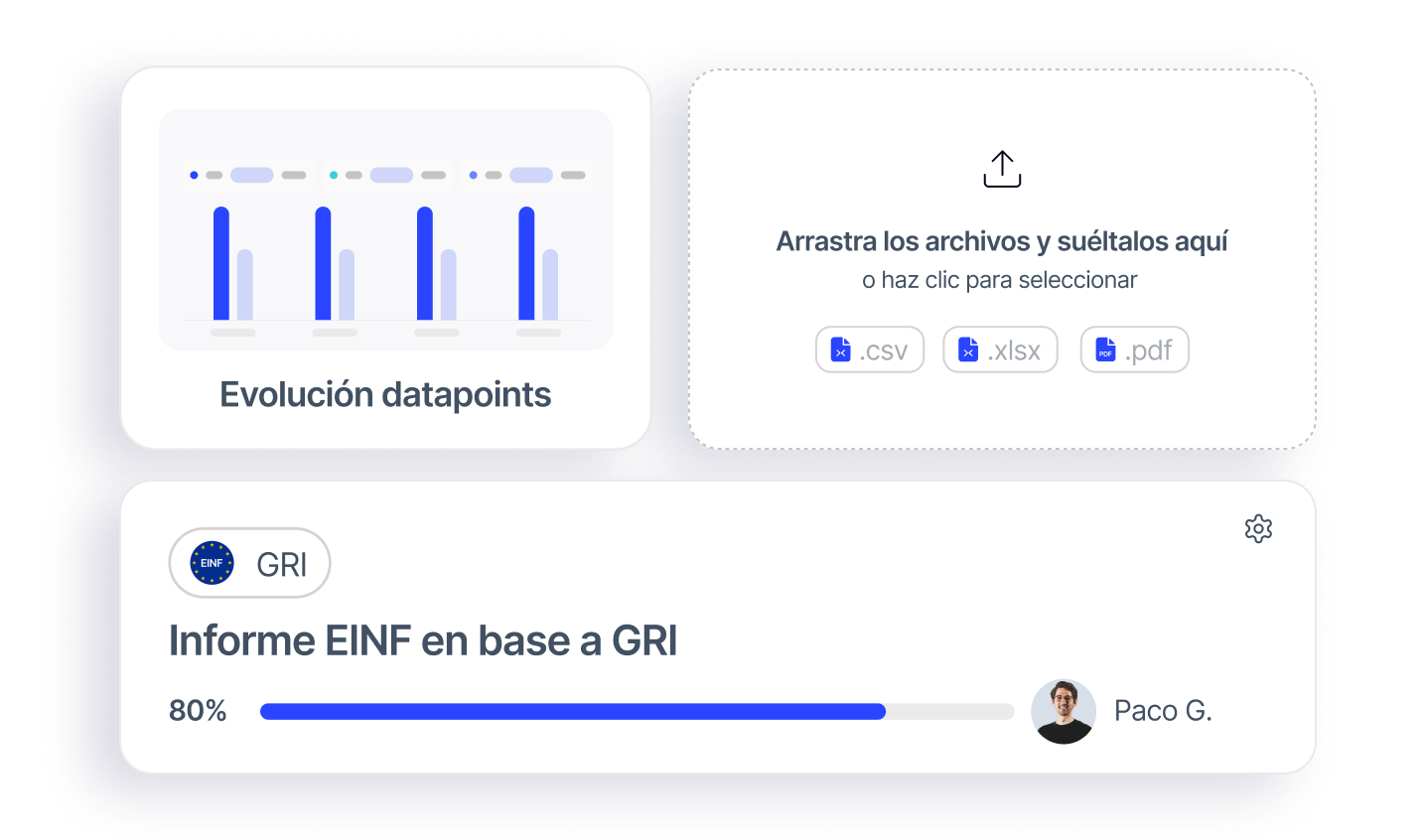
At Dcycle, we know how time-consuming EINF preparation can be — especially when ESG data lives in multiple systems.
That’s why we built a solution to make the process simple, automated, and scalable.
Here’s how it works:
With Dcycle, you don’t start from zero each year. You build a permanent system that updates automatically, adapts to new standards, and gives your company full control of its sustainability information.
The EINF as we know it is evolving. The CSRD is replacing the old Non-Financial Reporting Directive and will soon set the new European standard through ESRS (European Sustainability Reporting Standards).
That means your EINF will no longer be an isolated document — it will become part of a broader ESG reporting ecosystem.
The implications are clear:
If you prepare now — organizing your EINF data under a CSRD-ready structure — you’ll save enormous effort later.
With Dcycle, you can already prepare your reports following both frameworks simultaneously. So when CSRD becomes fully enforceable, you’ll already be one step ahead.
Even experienced companies fall into predictable traps.
Avoiding these pitfalls will not only save you time but also increase the strategic value of your report.
If you approach the EINF as more than a compliance exercise, it becomes a powerful management tool.
With a well-structured system, you can:
In short, the EINF can help you run a better, more resilient business — if you give it the structure and attention it deserves.
At Dcycle, we are dedicated to helping you measure your environmental impact and effectively communicate it to your stakeholders by providing you with the necessary tools to facilitate the collection and measurement of relevant data — from custom reporting to audit-ready dashboards — so that you can gain a clear understanding of your environmental performance, thus driving sustainability and corporate responsibility.
Carbon footprint calculation analyzes all emissions generated throughout a product’s life cycle, including raw material extraction, production, transportation, usage, and disposal.
The most recognized methodologies are:
Digital tools like Dcycle simplify the process, providing accurate and actionable insights.
Some strategies require initial investment, but long-term benefits outweigh costs.
Investing in carbon reduction is not just an environmental action, it’s a smart business strategy.



.png)


.jpg)