

Carbon footprint calculator
Calculate your company's carbon footprint for free. Scope 1 and 2 with DEFRA factors, downloadable report aligned with GHG Protocol and ISO 14064. No setup, no consultants.
- Your Scope 1 and 2 carbon footprint, broken down by scope and by month
- The report they'll ask you for, aligned with GHG Protocol and ISO 14064
- Your first footprint ready in minutes, not weeks
- No spreadsheets, no consultants, no credit card
 100% free
 Calculate your carbon footprint
- Scope 1 and 2 with recognised emission factors
- Automatic results in kgCO₂e and tCO₂e
- Aligned with the GHG Protocol
Instant access. No strings attached. Your data is protected.






What this carbon footprint calculator includes
The free calculator measures your Scope 1 and 2: own fuels (boilers, refrigerants, fleet), purchased electricity, heat and steam. Recognised emission factors and monthly breakdown, aligned with GHG Protocol and ISO 14064.
No spreadsheets, no manual formulas, no factors copied from a PDF. Enter your data and the calculation engine does the rest: results in minutes, not weeks.
Who can use this carbon footprint calculator
From sole traders and SMEs to large multi-site organisations. It adapts to any sector: industry, services, retail, logistics, food and technology.
Accuracy of a carbon footprint calculator vs generic methods
Generic spreadsheet methods use static emission factors and unvalidated formulas.
Dcycle applies recognised emission factor databases (DEFRA, IPCC, EPA) and guarantees full traceability from the raw data to the final result.
How to calculate your carbon footprint step by step
What data you need to calculate a carbon footprint
Electricity and gas bills, litres of fuel for your own fleet, business travel distances, tonnes of purchased materials and waste generated.
Dcycle guides you category by category, so nothing is left out.
How to calculate scope 1 and 2
Scope 1 covers your organisation's direct emissions: own fuels (boilers, processes), refrigerant gases and fleet. Scope 2 covers emissions tied to purchased energy: electricity, heat and steam.
With the free calculator you enter your activity data and get your footprint in minutes, with up-to-date official emission factors and a report ready with GHG Protocol and ISO 14064.
Real data vs estimates when calculating your footprint
A calculator based on real data (bills, consumption) produces verifiable results.
Generic estimates are fine for a first approximation, but they do not stand up to an audit or meet regulatory requirements.
Carbon footprint calculator and regulatory compliance
How to calculate a carbon footprint for CSRD
The CSRD requires you to report GHG emissions under the ESRS (European Sustainability Reporting Standards).
Dcycle generates the E1 data points tagged in XBRL, straight from the carbon footprint calculation.
How the calculator ties into SECR and environmental law
SECR in the UK, the EU CSRD and public procurement requirements all expect emissions data calculated with a recognised methodology. Companies bidding for UK contracts also need a carbon reporting approach that holds up.
Dcycle complies with the GHG Protocol and ISO 14064.
Preparing the carbon footprint calculation for audits
Every data point in Dcycle is traced from its source, an invoice, a contract, an activity record, all the way to the final figure.
Reports include the methodology, the emission factors and the complete evidence trail for third-party assurance.
How to reduce your carbon footprint after calculating it
Quick wins after calculating your carbon footprint
Identify the highest-weighted emission sources and prioritise high-impact measures: switching to renewable energy, optimising fleets, cutting waste and improving energy efficiency across sites.
Emissions reduction strategy
Dcycle helps you set science-based targets (SBTi) and design a decarbonisation plan with measurable milestones.
Compare your year-on-year trend and adjust the strategy with real data.
Tracking after using a carbon footprint calculator
Calculating a carbon footprint is not a one-off exercise.
Dcycle enables continuous tracking, with automatic metric updates and alerts when the data drifts from your targets.
Get your free carbon footprint calculator
Measure scope 1 and 2 with the free Dcycle calculator. Ready to use, no consultants.
Calculate my footprint free →The difference between a carbon footprint calculator and ESG software
| Feature | Free calculator | Dcycle |
|---|---|---|
| Scopes covered | 1 and 2 (partial) | Full 1, 2 and 3 |
| Emission factors | Generic / out of date | DEFRA, IPCC, EPA - up to date |
| Traceability | None | Data → factor → result |
| Audit-ready reports | No | ISO 14064 / GHG Protocol |
| Multi-site / multi-entity | No | Yes, with consolidation |
| ERP integration | No | SAP, Sage, Dynamics, API |
| CSRD compliance | No | ESRS E1 - XBRL tagged |
| Reduction plan | No | SBTi targets + tracking |
Limits of a free carbon footprint calculator
Free calculators work as a first approximation, but they offer no traceability, do not update automatically, do not produce audit-ready reports and cannot manage multiple sites or periods.
For regulatory compliance and ongoing management, you need a platform like Dcycle.
When to move from a calculator to carbon footprint software
When you need audit-ready results, when you have more than one site, when your customers ask for verified data, or when regulation requires it (CSRD, SECR, procurement).
At that point, a generic calculator is not enough.
Advanced emissions management
Dcycle offers multi-entity management, roles and permissions, ERP integration (SAP, Sage, Dynamics), full traceability and multi-framework reporting.
A simple calculator does not cover these needs.
What is a carbon footprint calculator
What a carbon footprint calculator is for
To quantify the greenhouse gas (GHG) emissions tied to a company's activities.
The result is expressed in tonnes of CO₂ equivalent (tCO₂e) and becomes the basis for reporting, the reduction strategy and regulatory compliance.
What a carbon footprint calculator measures
It measures emissions of CO₂, CH₄, N₂O and other GHGs from your organisation: direct emissions (combustion, refrigerants, own fleet) and emissions tied to purchased energy (electricity, heat, steam). The result is expressed in tonnes of CO₂ equivalent (tCO₂eq).
How a carbon footprint calculator works
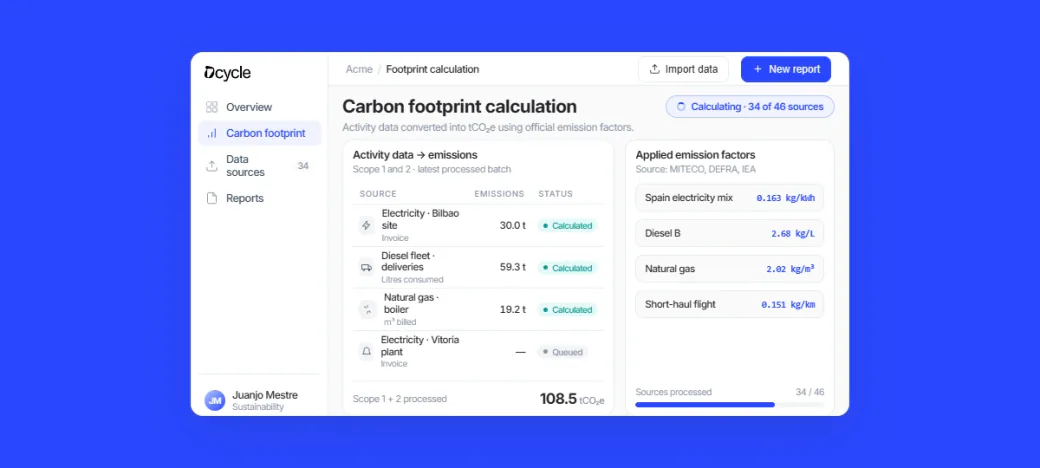
The base formula is: Emissions = Activity data × Emission factor.
Dcycle automates this: it collects the activity data, selects the correct emission factors by source and country, and produces the result with full traceability.
What a carbon footprint is and how it is calculated
What calculating a carbon footprint means
It means accounting for the total GHGs emitted directly and indirectly by a company's activities over a given period, usually a financial year.
The calculation must follow a recognised standard such as the GHG Protocol.
Carbon footprint calculation examples by sector
The profile changes drastically depending on each company's sector, size and value chain.
Main emission sources for Scope 1 and 2
The relative weight shifts by sector: services lean on electricity, industry on process fuels, logistics on own fleet. The free calculator returns your real mix by source, not a sector average.
Seeing the breakdown by source is the first step to identify where to cut: green electricity contract, energy efficiency, fleet electrification, replacement of high-GWP refrigerant gases.
Resources to calculate and cut your carbon footprint
Carbon footprint software
Automate your carbon footprint with auditable traceability and reports ready for CSRD and ISO 14064.
See the platform → GHG ProtocolGHG Protocol Scope 2 changes
The standard revision changes how purchased-electricity emissions are calculated. What it means and when it applies.
Read the guide → UKCarbon reporting for UK businesses
How SECR and procurement requirements shape carbon reporting for UK companies.
Read more → SoftwareCarbon footprint measurement software
What to look for in a tool to measure emissions with recognised methodology.
Read more → ProductProduct carbon footprint
How to calculate a product's footprint with life cycle assessment (LCA).
Read more → DemoTalk to an expert
Need to cover the full value chain or audit-ready reports? We show you how in a demo.
Request a demo →Frequently asked questions about the carbon footprint calculator
What is a carbon footprint?
It is the total amount of greenhouse gases (GHG) generated by an activity, a person, a product or an organisation, expressed in tonnes of CO₂ equivalent (CO₂e). Calculating it is the first step to knowing where you can cut emissions.
How is a carbon footprint calculated?
You multiply your activity data (energy used, fuel, distance travelled, materials, waste) by the corresponding emission factor. The sum, converted into CO₂ equivalent, is your carbon footprint. A calculator automates the process by applying the official emission factors for you.
How can I calculate my carbon footprint for free?
You can calculate it for free with the Dcycle calculator from this page. It covers scope 1 and 2 using recognised emission factors and follows the GHG Protocol methodology.
What is a carbon footprint calculator?
It is a tool that quantifies your GHG emissions automatically from your activity data, without you having to look up emission factors or do the maths by hand. The result is expressed in tonnes of CO₂ equivalent, broken down by source.
What data do I need to calculate my carbon footprint?
Mainly your consumption: electricity and gas bills, litres of fuel, distance travelled and, where relevant, purchased materials and waste generated. The more complete and traceable the data, the more accurate the footprint.
What are scopes 1 and 2?
They are two of the GHG Protocol categories. Scope 1 covers your direct emissions: own fuels (boilers, processes), refrigerant gases and fleet. Scope 2 covers emissions tied to purchased energy: electricity, heat, steam. Our free calculator measures both and gives you a report aligned with GHG Protocol and ISO 14064 in minutes.
What unit is a carbon footprint measured in?
In tonnes or kilograms of CO₂ equivalent (CO₂e). CO₂ equivalent lets you add every greenhouse gas into a single figure, weighting each one by its global warming potential.
Is a free carbon footprint calculator reliable?
For an initial estimate, yes. For regulatory compliance (CSRD, SECR, ISO 14064) or external assurance you need data traceability, up-to-date factors and audit-ready reports, which a basic calculator does not offer but a professional tool like Dcycle does.
Does the calculator work for SECR and CSRD reporting?
It helps you calculate the emissions you need for SECR (Streamlined Energy and Carbon Reporting) in the UK and for the CSRD in the EU. For the full disclosure and assurance, Dcycle produces reports with the traceability and methodology these frameworks require.
What is the best carbon footprint calculator?
The one that combines a recognised methodology (GHG Protocol, ISO 14064), official and up-to-date emission factors, full data traceability and audit-ready reports. For a one-off calculation a free calculator is enough; if you need to report or get assured, Dcycle brings it all together in a single platform.
Start now with your free carbon footprint calculator
Calculate your carbon footprint for free and see how Dcycle automates the full calculation. No strings attached.
Calculate my footprint free →